
 Pricing
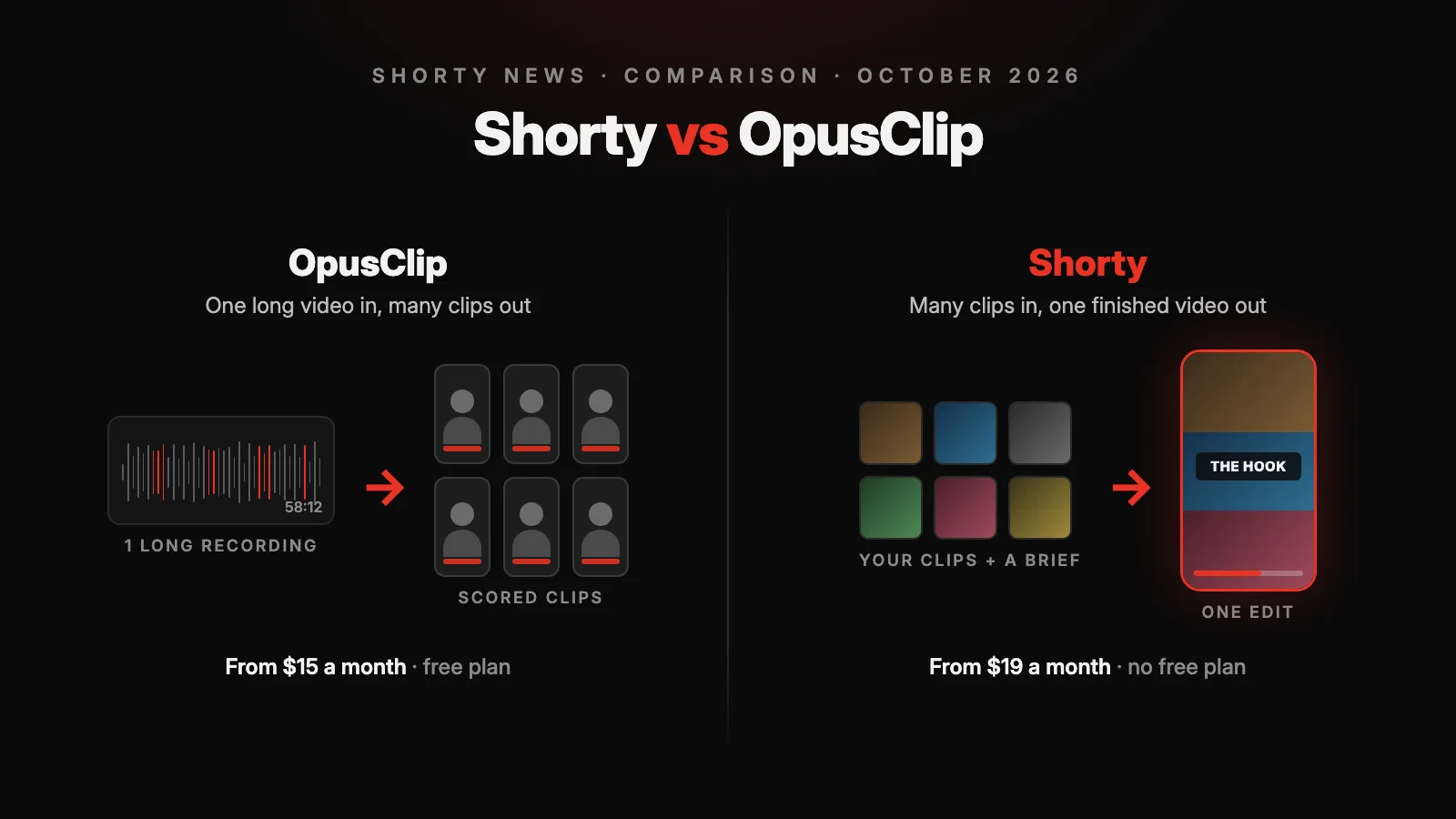
Shorty is an AI video editor that turns your own clips into a finished short video from a written brief or a video you want to copy. OpusClip started as a clipper that finds the best moments in a long video and turns them into captioned vertical clips, and now adds AI Producer, a chat-based agent that edits one talking-to-camera video with captions, motion graphics, B-roll and music. There is no single best one. There is a best one per job: OpusClip for turning podcasts, webinars and streams into many clips, for posting and scheduling them, and for a single talking-head take; Shorty for Reels, TikToks and Shorts cut from several clips, especially when you have a reference. Paid plans start at $19 a month on Shorty ($13 billed annually) and $15 a month on OpusClip Starter (monthly only), with OpusClip Pro at $29 ($14.50 billed annually), and OpusClip also has a free plan.
What Is the Difference Between Shorty and OpusClip?
Shorty starts from the video you want. You add clips or photos, then describe the result or upload a reference, and Shorty plans the cut, picks the shots across all of them, adds captions, music and effects, and renders an MP4. You change it by asking: select a title or a moment in the preview and say what should happen.
OpusClip starts from a recording. Its clipping tool reads a long video, picks the moments most likely to work as shorts, gives each a Virality Score, reframes it to vertical and adds animated captions; you then post or schedule the clips to YouTube Shorts, TikTok and Instagram Reels. AI Producer is the newer route: upload one video of a person speaking to camera, describe the cut in a chat, and it returns an edit with captions, motion graphics, B-roll, music and sound that you can change in the same chat.
Both reach past their core. Shorty grades color, tracks objects and narrates with an AI voiceover; OpusClip dubs video, generates AI B-roll, exports projects to Adobe Premiere Pro and DaVinci Resolve, and runs a social media scheduler. The difference is what each one starts from: OpusClip from one recording, Shorty from many clips.
This comparison is published by Shorty. OpusClip’s side comes from its own pricing page, help center, AI Producer docs and product pages, checked on 29 October 2026. There are no affiliate links.
Shorty and OpusClip, Feature by Feature
| Task | Shorty | OpusClip |
|---|---|---|
| Where you start | Your clips or photos, plus a written brief or a reference video to copy | A long video to clip (up to 10 GB a file, 30 GB on Pro), or one talking-to-camera video for AI Producer |
| Editing by instruction | The brief, then revisions: select a title, object or moment and describe the change | AI Producer: a brief in a chat, then changes in the same chat; on clipping, a prompt to steer which moments are picked |
| Editing by hand | No timeline; changes are made by asking | Timeline and text-based editing in the OpusClip editor on paid plans; the free plan has no editing |
| Copying a video’s style | Upload it as a reference: Shorty follows its pacing, shot structure, text and color | Uploading a video to copy its edit is not described on OpusClip’s pages; brand templates set captions, fonts and intro and outro cards |
| Footage per project | Up to 150 clips or photos and 8 GB per edit, from uploads, Google Drive, Dropbox or a dropped folder; Pixabay stock | AI Producer: one speaker video, MP4, MOV or WebM up to 5 minutes and 1.99 GB; multi-camera edits and screen recordings are not supported yet |
| Clips from a long video | Shorty cuts one finished video from your clips, or up to 50 in a batch | AI clipping with a Virality Score, auto hook and clip lengths from under a minute to 15 minutes |
| Talking-head cleanup | Filler-word removal, noise reduction and loudness levelling in the edit | Pause and filler removal; bad-take removal, speech enhancement and eye contact correction on Pro |
| Captions | Designed for each edit; SRT or VTT download | Animated captions in 20+ languages with emoji and keyword highlights; a subtitle file download is not described on the pages we checked |
| B-roll and dubbing | Your own clips placed by Shorty; Pixabay stock; no translation or dubbing | AI image and stock B-roll (3 clips a month each on Starter), AI video B-roll and video dubbing on Pro |
| Export and posting | MP4 in seven vertical, square and wide formats; write “4K” for a 4K delivery | MP4 up to 1080p with a watermark on Free; auto-posting on paid plans; scheduler, 9:16, 1:1 and 16:9, and Premiere Pro or DaVinci Resolve export on Pro |
| Plans | Creator $19, Pro $49, Studio $99, Max $199 a month; 30% off billed annually | Free; Starter $15 a month (monthly only); Pro $29 a month ($14.50 billed annually); Business on request |
Sources: OpusClip pricing · OpusClip AI Producer docs · OpusClip AI video editor · OpusClip plans · Shorty pricing.
How Does Editing Work on Each Platform?
On Shorty, you choose how to direct the edit. A brief can be one sentence or a paragraph: the length, the hook, where the product shows up, the captions you want or don’t. A reference is a video you like, uploaded or picked from Discovery, and Shorty rebuilds its rhythm, shot order, text and color with your own footage. You can use both in the same edit.
Shorty then watches every clip, picks the moments, cuts them to the music, reframes them for the format, and adds captions, titles and sound effects. The finished edit opens in a preview. Click the title and write “make it red”, or ask for a darker grade, a shorter hook or more clips, and Shorty makes a new version without starting over.
On OpusClip, there are two ways in. For clipping, you import a long video, choose the part of it to process and the clip length, and OpusClip returns a set of scored clips, already reframed and captioned, that you trim in the editor and post. For AI Producer, you drop one talking-to-camera video onto a new project, write the brief while it uploads, and review the first cut on the project page. Its skills cover a rough cut that removes filler words and pauses, captions, motion graphics, camera movement, auto layout, auto B-roll and voice cleanup, with music and sound effects in beta. Each request in the chat updates the same project.
OpusClip is built around one recording and the speech in it. Shorty is built around several clips and the story across them.
How the Editing Compares
| Criteria | Shorty | OpusClip |
|---|---|---|
| What the AI works from | Every clip’s pictures and sound, the brief, and the reference if you add one | One recording: its transcript and footage, plus your brief in AI Producer |
| Your first result | A rendered edit with captions, music and effects | Clipping: a set of scored, captioned clips. AI Producer: a first cut with captions, motion graphics and sound |
| Changing a title or a moment | Select it in the preview and describe the change | Ask in the AI Producer chat, or change it on the timeline or transcript in the editor |
| Putting several clips in order | Shorty chooses and orders the shots across all your clips | AI Producer works on one speaker video per project; in the editor you reorder scenes yourself |
| Many videos at once | Batches of 4 to 50 videos, by plan | Many clips from one long video in a single run |
| Main limitation | No timeline for frame-exact trims, masks or keyframes, and no translation or dubbing: finish the MP4 in another editor | AI Producer takes one person speaking to camera, up to 5 minutes, and exports up to 1080p at 30 fps; its credit cost per edit is not published |
How Do You Make the Same Video on Each Platform?
The task: a 30-second vertical video for Reels and TikTok, made from your own footage: one three-minute talking-to-camera take and five 20-second B-roll clips of the product, with captions and music. Then one change to the finished video, and a subtitle file. On OpusClip, AI Producer is the right tool for the take, and the editor is where your own clips go in.
| Step | Shorty | OpusClip |
|---|---|---|
| Footage | Drop the six clips in, from your computer, Google Drive or Dropbox | Start a new AI Producer project and upload the talking take; keep the five B-roll clips for the editor |
| Direction | Write the brief, for example “30 seconds, hook in the first line, B-roll over every product mention”, or upload a reference | Write the brief in the chat, for example “30 seconds for TikTok, hook first, keep it upbeat” |
| Clean speech | Add “remove the ums” to the brief | The rough-cut skill removes filler words and pauses; voice cleanup evens the sound |
| Length | Set in the brief | Set in the brief; ask for a shorter cut in the chat if needed |
| Vertical frame | Choose 9:16; Shorty reframes every shot | AI Producer exports in the take’s own orientation, so shoot it vertical, or reframe it to 9:16 in the editor |
| B-roll | Placed from the brief or the reference | Auto B-roll adds clips to match what is said; to use your five clips, bring the video into the editor, upload them as media assets (Pro) and place them on the timeline |
| Captions and music | Arrive with the edit, with sound effects | Word-synced captions from AI Producer; music is in beta there, or add it in the editor on Pro |
| One change | Select the hook title and write “shorter, and in red” | Ask for it in the same chat, or edit the text in the editor |
| Subtitle file | Subtitles → Download SRT | Not described on the pages we checked; captions are burned into the video |
| Export | MP4; write “4K” for a 4K version | One MP4 up to 1080p at 30 fps, to download or share as a project link |
Which One Gets There Faster?
For the talking take on its own, OpusClip is quick: one upload and a short brief give you a cut with captions, motion graphics and B-roll it finds for you, and changes happen in the same chat. If the three-minute take were a one-hour podcast, OpusClip’s clipping would be the shorter path by far, with a dozen scored clips from one upload. What takes longer on OpusClip is the part across clips: AI Producer edits one speaker video per project, so your own five B-roll clips go in by hand in the editor. Shorty gets from six clips to a finished 30-second edit in fewer steps, because the story, the B-roll placement, the framing and the captions arrive together, and it hands you a subtitle file. If your video is one person talking, OpusClip is the shorter path. If you want the edit made from several clips, Shorty is.
Steps are based on each product’s documentation and help pages, checked October 2026.
How Much Does the Same Video Cost?
Both charge credits. Shorty publishes what an edit uses on average and shows the estimate before you start. OpusClip publishes the price of clipping, 1 credit per minute of video imported, and says AI Producer takes credits in slices as the work runs, without publishing how many an edit uses. So these are the published numbers, not a bill. Plans used for the estimate, monthly billing:
| Criteria | Shorty Creator | OpusClip Starter | OpusClip Pro |
|---|---|---|---|
| Price | $19 a month | $15 a month, monthly only | $29 a month ($14.50 billed annually) |
| Allowance | 4,400 credits | 150 credits | 300 credits, 2 seats |
| Cost per unit | ≈$0.0043 a credit | $0.10 a credit | ≈$0.097 a credit (≈$0.048 billed annually) |
| Also included | Every editing tool, effect and caption style | No watermark, editor, filler and silence removal, auto-posting, 1 brand template | Uploading your own media, music, AI B-roll, speech enhancement, dubbing, scheduler, 100 GB storage |
One Video, One Change and a Subtitle File
| Step | Shorty Creator | OpusClip Pro |
|---|---|---|
| Footage, 4 min 40 s | No separate allowance; more footage raises the edit’s credits | Importing a video into the clipping editor costs 1 credit a minute (≈$0.10 a minute) |
| The edit | About 594 credits on Auto (≈$2.56), or about 100 on GPT 6 Luna (≈$0.43); more with lots of footage or a reference | AI Producer: credits taken in slices as the work runs; the amount is not published |
| Your own B-roll and music | Part of the edit | Placed by hand in the editor on Pro |
| Captions | Part of the edit | Part of AI Producer’s edit |
| One change | Uses credits; Shorty shows the estimate before it runs | A chat request uses AI Producer credits, amount not published; a change by hand in the editor has no listed charge |
| Subtitle file | No separate charge listed | Not described on the pages we checked |
| Total | From ≈$2.56 on Auto or ≈$0.43 on GPT 6 Luna, plus the change | Not published: AI Producer’s credits plus about 1 credit a minute for any import, inside Pro’s $29 a month |
A Series of 10 Videos
Most people make more than one. Here is a month of ten videos like this one.
| Criteria | Shorty | OpusClip |
|---|---|---|
| Media | No separate allowance | About 47 minutes of footage; any video imported for clipping or editing uses 1 credit a minute, out of Pro’s 300 |
| Edits | About 5,900 credits on Auto: more than Creator’s 4,400, inside Pro’s 12,600 ($49). About 1,000 on GPT 6 Luna, inside Creator | Ten AI Producer edits; their credit use is not published, so check your credits usage after the first one |
| Your time | Review each edit and ask for changes | Placing your own B-roll on the timeline in every video |
| Plan that fits | Creator on GPT 6 Luna, Pro on Auto | Pro, for your own media, music and 9:16, 1:1 and 16:9; each extra pack adds 300 credits a month and 2 seats, up to 4 seats |
Sources: OpusClip pricing · OpusClip: how credits work · OpusClip AI Producer docs · Shorty pricing · What a Shorty edit costs.
Retries, Top-Ups and Leftovers
AI edits sometimes take another try, so plan for revisions. On Shorty, a revision uses credits and a failed edit returns its credits. On OpusClip, a Pro user can refund a clipping project’s credits up to 14 days after upload, as long as no clip has been downloaded, and upload again. An AI Producer run stops when the account can’t cover its next slice of credits.
OpusClip’s monthly credits expire after 60 days, so they roll over for one more month; yearly plans grant the year’s credits up front, valid for 12 months, at half the monthly rate. For more, you buy top-up credits, repurchase your plan or add Pro packs, which starts a new billing cycle. Moving from Starter to Pro starts at once, for the prorated difference, and your credits carry over; downgrades happen at the end of the cycle. On Shorty, a bigger plan starts the day you switch and its credits are added on top of yours.
Prices were checked on 29 October 2026 on OpusClip’s pricing page and help center and on Shorty’s pricing page, in US dollars at monthly rates before tax.
Which Should You Choose: Shorty or OpusClip?
There is no single best choice between Shorty and OpusClip. There is a best one per job.
| Your main task | Better fit | Why |
|---|---|---|
| Turning podcasts, webinars or streams into many clips | OpusClip | AI clipping finds the moments, scores them, reframes the speaker and captions every clip from one upload |
| Posting and scheduling clips to TikTok, Shorts and Reels | OpusClip | Auto-posting on paid plans and a social media scheduler on Pro |
| One talking-to-camera take, edited by chat | OpusClip | AI Producer adds captions, motion graphics, B-roll and music to a single speaker video, from $15 a month |
| Reels, TikToks or Shorts from several clips | Shorty | Plans the cut across all your clips and renders it with captions, music and effects |
| Recreating a video you admire with your own footage | Shorty | Upload it as the reference; Shorty follows its pacing, shots, text and color |
| Many short videos from different shoots every week | Shorty | Batches of 4 to 50 videos; about 44 GPT 6 Luna edits a month on Creator |
Choosing for Your Kind of Video
Podcasts, interviews and streams. If you already have long recordings, OpusClip is built for them. Import the episode, let it pick and score the moments, adjust the captions and post the clips on a schedule. One upload can fill a week of shorts.
Talking heads. If your video is one person speaking to camera, both work. OpusClip’s AI Producer starts from that one take and is cheaper to enter; Shorty is the better fit when the take has to be cut together with B-roll, product shots or other clips you filmed.
Short-form from many clips. If you shoot several clips on your phone and need a Reel, TikTok or Short out of them, Shorty does the part OpusClip leaves to you: choosing the best moments across all of them, putting your B-roll in place, framing every shot for vertical and timing captions and music. A style you have seen and want to copy goes in as the reference.
Switching. Projects don’t move between the two, only rendered video. Moving to Shorty, download an OpusClip clip you liked as an MP4 and upload it as the reference, so your next edit keeps the style. You can also use both: clip the podcast in OpusClip, then add the best clip to Shorty with your B-roll for a finished Reel.
Go Deeper
Shorty vs OpusClip: the quick comparison
Workflow, control, output and pricing on one page.
OpusClip alternatives by editing style
Which editor to pick for each kind of video, and how to switch.
AI video editor or long-video clipper?
How to tell which kind of tool your videos need.
What a Shorty edit costs
Every plan, with the cost of an edit worked out in dollars.
Reference Match 2.0 and Talking Heads
How Shorty copies a video you love and keeps a speaker centred.
Shorty pricing
Plans, credits and batch sizes.
Frequently Asked Questions
Is Shorty or OpusClip better for short-form video?
For short videos cut from several clips, Shorty: it chooses the shots, places your B-roll, frames every shot for vertical and adds captions, music and effects, then renders the edit. OpusClip is better for turning one long video into many clips, and its AI Producer edits a single talking-to-camera take by chat. If you post the clips straight to TikTok, Shorts and Reels on a schedule, OpusClip does that too.
Do Shorty and OpusClip have free plans?
OpusClip does: the free plan gives 60 credits a month, clips up to 1080p with a watermark, no editing, and three days to export them. Shorty doesn’t; its plans start at $19 a month, or $13 a month billed annually, with every editing tool on every plan.
Can I give either tool a video to copy?
In Shorty, yes. Upload it as the reference, or pick one from Discovery, and Shorty follows its pacing, shot structure, text and color with your own footage. OpusClip’s pages don’t describe uploading a video to copy its edit; its brand templates keep captions, fonts and intro and outro cards consistent.
How much does an AI edit cost on each?
On Shorty Creator, an edit uses about 594 credits on Auto, about $2.56, or about 100 on GPT 6 Luna, about 43 cents, and Shorty shows the estimate before you start. On OpusClip, clipping costs 1 credit per minute of video imported, about 10 cents a minute on Starter or Pro monthly. AI Producer takes credits in slices as it works; OpusClip doesn’t publish how many an edit uses.
Can AI Producer edit several clips together?
Its docs describe one person speaking to camera per project, in a single MP4, MOV or WebM file up to 5 minutes, and say multi-camera edits and screen recordings are not supported yet. To add your own B-roll, you use the OpusClip editor, where Pro lets you upload media and place it on the timeline. Shorty takes up to 150 clips or photos in one edit and orders them for you.
What happens after I cancel?
On Shorty, you cancel in your Stripe billing settings and the plan stays active until the end of the period you paid for. On OpusClip, you open Subscription, choose Manage plan and then Cancel subscription; the change takes effect at the start of the next billing cycle, and remaining credits expire on their original date.
Clip the long ones in OpusClip, cut the short ones in Shorty, or use both. Go make something.
The Shorty Team
Bring your clips. Get the finished cut.
Add your footage, describe the video or upload one you like, and Shorty makes the edit, captions and music included.
Start creating